 English
 Nederlands
 Français
 Deutsch
 Español
 Polski
 Русский
 العربية
 Română
Call us on +32 (0) 51 57 58 58 or contact us.
Steering system for MAN / Mercedes trucks, buses and vans

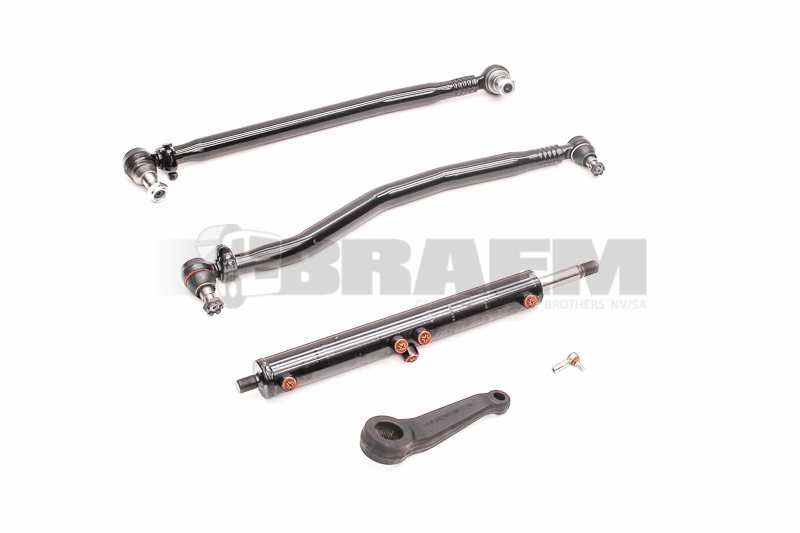

The steering system is one of the most decisive systems for safety, control and driving precision in MAN and Mercedes trucks, coaches and vans. Every day, drivers rely on direct and predictable steering response, regardless of vehicle weight, speed or road conditions. In professional applications, the steering system is heavily loaded by heavy axles, long driving hours, manoeuvres in tight locations and changing surfaces. Wear or defects in steering components therefore have immediate consequences for road safety. At Braem you will find an extensive range of steering parts that allow repairs to be carried out correctly, reliably and durably.
The role of the steering system within the vehicle
The primary role of a truck’s steering system is to change and control the vehicle’s direction of travel in a safe, accurate and comfortable way. The movement the driver makes with the steering wheel is transmitted through the steering system to the front wheels. By turning these wheels, the vehicle can take corners and change lanes. A properly functioning steering system ensures good straight-line stability. Straight-line stability is a vehicle’s ability to keep driving straight ahead by itself without the driver constantly having to correct the steering. Hydraulic or electric power steering ensures that the driver needs less force to turn the steering wheel. A good steering system provides good feedback to the driver. Information about the wheels and the road surface can be felt in the steering through the steering system.
Main steering components and how they work
The driver turns the steering wheel. This steering wheel is connected via the steering column and a telescopic intermediate shaft to the steering gear. The steering gear converts the rotational movement of the steering into a linear movement in the longitudinal direction of the vehicle (forward and backward) via the pitman arm. This is connected via the drag link through the steering arm to the steering knuckle. This converts the linear movement of the pitman arm into a swivelling movement of the front wheel. To ensure that both wheels on the same axle swivel in the same way, the left and right steering knuckles of the same axle are connected via steering arms by a tie rod. In vans, a steering rack is usually used instead of a steering gear. With a steering rack, the rotational movement of the steering, which is connected via the steering column, is converted into a linear movement in the transverse direction of the vehicle (left and right). The ends of the steering rack are attached to the steering arms of the steering knuckles via ball joints. This allows the wheels to swivel while the steering rack moves linearly. Depending on the power steering system, a power-steering oil circuit is fitted on a truck. The power steering pump is mounted on the engine and is connected to the steering gear via lines. When the engine is running, the power steering pump ensures constant circulation of power-steering oil in the circuit under constant pressure. The oil is also filtered in the power-steering reservoir and filter by means of a power-steering oil filter. Inside the steering gear there is a mechanism whose operation is boosted when the driver operates the steering wheel. When the vehicle is driving straight ahead, the steering wheel is not operated. The internal control valve of the steering gear is in the neutral position, so the oil flows back to the power-steering reservoir without additional pressure. As a result, there is no pressure difference in the steering gear. In this case, there is no power assistance. When the driver operates the steering wheel, the steering system encounters resistance from the wheels that are in contact with the road surface. This means the internal control valve of the steering gear is no longer in the neutral position. The internal mechanism of the steering gear is subject to pressure differences, causing the oil channels to one side to open. In this situation, power assistance is active and the driver is assisted while steering.
Interaction with the engine
The power steering pump ensures continuous circulation of power-steering oil under constant pressure in the power steering system. For this, the power steering pump is mounted on the air compressor housing that is fitted to the engine. The drive shaft of the power steering pump is connected via a coupling to the crankshaft of the air compressor, so they rotate at the same speed. In vans, the power steering pump is mounted on the engine block. The crankshaft of the engine and the power steering pump are fitted with a pulley around which a V-belt or serpentine belt runs. This belt is tensioned by means of a belt tensioner. This causes the drive shaft of the power steering pump to rotate when the engine is running. The same belt drive also drives the alternator, the water pump, the A/C compressor and, on older engines, the fan.
Common wear and symptoms that require attention
All moving parts are subject to wear. This can lead to play and looseness in the steering wheel. The steering wheel feels loose or responds slowly, and the wheels do not turn along immediately. This reduces steering precision, which is dangerous at high speed and with heavy loads. Drag links and tie rods have ball joints at the ends. Ball joints (also called spherical joints) ensure that steering movements are transmitted smoothly, while movements of the suspension and irregularities in the road are absorbed. They absorb movement by allowing motion in multiple directions. A ball stud is mounted in a seat. Between them is grease that guarantees smooth movement. Due to friction, loss of lubrication and metal fatigue, the ball joint wears. This can be heard as knocking noises on uneven road surfaces. Uneven tyre wear occurs. In the steering gear, a rack works together with a worm gear that are supported by bearings in the steering gear housing. This is a mechanical connection subject to wear. As a result, the steering gear loses its precision or fails. We hear a rattling noise when the vehicle turns. A poorly functioning power steering pump, leaks in the power-steering oil circuit and contamination in the power-steering oil can no longer guarantee continuous circulation of power-steering oil under constant pressure. This causes the power steering to fail. Steering becomes more difficult.
The importance of timely steering system maintenance
A well-maintained steering system prevents accidents, consequential damage and downtime. Timely maintenance guarantees safety ensures steering remains reliable and precise and reduces wear so major repairs can be avoided. The vehicle must comply with inspection requirements and legislation at all times.
Preventive action and proper vehicle alignment increase safety and reduce costs.
Vehicle alignment is the correct adjustment of the wheel positions relative to each other and to the chassis, so that the vehicle drives straight, steers stably and the tyres wear evenly. The steering system has a direct and major influence on vehicle alignment because it determines how, and in what position, the front wheels sit relative to each other and to the chassis. On trucks, the most important alignment angle is toe. The wheels of the front axle must be parallel to each other. The tie rod is mounted between the left and right wheel of the front axle. By changing the length of this tie rod, the wheels can be set parallel to each other. The tie rod has adjustable ball joints at the ends to adjust its length. Correct toe improves straight-line stability and extends tyre service life. The second alignment angle is camber. Camber is the inclination of the wheel relative to a vertical line, viewed from the front or rear of the vehicle. This vertical line is defined as the line in the direction of gravity. This vertical line is independent of road slope. For trucks, a slightly negative camber is targeted: i.e. the top of the wheel leans towards the centre of the vehicle. Slightly negative camber on a truck compensates for vehicle roll in corners, so the wheels maintain optimal contact with the road, ensuring grip, even tyre wear and stable steering behaviour. Camber is difficult to correct on trucks because fixed connections are used. The front wheel is mounted on the wheel hub, which is rigidly connected via the steering knuckle and the steering knuckle kit to the front axle beam. A poor camber value may indicate that the front axle suspension mounting is worn. The front axle suspension mounting is the system that secures the front axle to the chassis or the vehicle’s suspension, and keeps it rotating and stable. A poor camber value can be the result of worn wheel hub bearings or deformed control arms. The third alignment angle is caster. Caster is defined as an angle in degrees measured between the centreline of the kingpin and a vertical line perpendicular to gravity, viewed from the side of the vehicle. On trucks, positive caster is used. In this case, the kingpin is tilted rearward, optimizing stability, steering self-centre and predictable cornering behaviour.
Repairing, reconditioning or replacing steering parts
The steering gear can be reconditioned if it can still be repaired internally without compromising safety or functionality. Reconditioning is the inspection and repair of a vehicle component so that it functions optimally again. Damaged drag links, tie rods and ball joints are always replaced if damaged or deformed. If repaired steering parts compromise safety, the only option is to replace these steering parts with new ones.
When repair is justified
Leaks in the power-steering oil circuit can be repaired by replacing seals. Hydraulic lines can be replaced without dismantling the entire steering gear.
When replacement of the steering gear is necessary
If there is play in the steering gear, internal wear or structural damage, replacement is the only safe solution. Continuing to drive with a defective steering gear increases the risk of sudden steering failure and seriously endangers the safety of the driver and the surroundings.
Steering system matched to use and load
A heavy vehicle is a vehicle with a high unladen weight and payload, designed for transporting heavy loads. For this, the vehicle must be configured with multiple axles. Multiple axles are needed to distribute the high vehicle weight and load, ensuring safety, stability and permissible axle load. Some of these axles are steerable to reduce the turning circle and limit tyre wear on heavy and long vehicles. For this purpose, the existing primary steering system is expanded with a hydraulic steering system with assist cylinders. This is applied when steering effort, steering precision or the number of steered axles increases and the primary system no longer suffices. A hydraulic steering system with assist cylinders converts the driver’s steering input into hydraulic pressure, which steers multiple axles simultaneously via main and assist cylinders, keeping heavy or multi-axle vehicles manoeuvrable and controllable.
Practical advice and an experience-based step-by-step plan to maintain the steering system properly
Visual inspection
- Check the steering components for cracks or damage, wear and fluid leaks. Check the mounting bolts and nuts.
- Inspection of the hydraulic system
- Check the oil level of the power-steering oil in the power-steering reservoir. Check the quality of the power-steering oil. Install a new power-steering oil filter. Check hoses, lines and couplings for leaks. Check whether hydraulic assist cylinders move smoothly.
- Play inspection
- Set the wheels straight ahead. Move the steering wheel back and forth and feel whether there is excessive play in the steering gear, the drag links, the tie rods and the ball joints. Check the bearing of the pitman arm. Check the intermediate shaft that is mounted in the steering column.
- Inspection of the assist cylinders
- Check whether the assist cylinders of multi-axle vehicles respond correctly when turning the steering wheel. Check connection points between primary and secondary axles.
- Noise inspection
- Worn steering parts can creak or grind. A ticking and knocking noise is caused by loose mounting parts. A poorly functioning power steering pump causes a whistling or humming noise.
- Check lubrication with grease
- Grease-lubricated steering parts via the grease nipples with a grease gun or check the central lubrication.
The added value of Braem for steering parts
Braem has an extensive stock of steering parts for MAN and Mercedes trucks, buses and vans. Thanks to fast availability and technical expertise, repairs can be carried out efficiently and reliably.
Customers choose Braem because of:
- Good quality through thorough quality control
- Braem reconditions certain steering parts
- Technical support during disassembly and installation
- Fast delivery within Europe and beyond
- Transparent warranty and return conditions
A well-maintained steering system is essential for safety, driving comfort and a long vehicle service life.